· Newsletter 01
E8 Audio Labs
September 2026
Mosaic, Collage, and a first look at Temper.
About Us
Founded in 2026, E8 Audio Labs is an audio software development based in Los Angeles, CA dedicated to crafting novel audio production instruments and effects for DAW-based producers, musicians, and sound designers. We bring emerging AI capabilities into our research and development, exploring the latest scientific work in acoustics, physical modeling, and digital signal processing to create advanced, expressive production tools.
Our focus is turning complex ideas into hands-on musical control: sounds you can shape, movement you can perform, and workflows that encourage experimentation.
Looking ahead, our goal is to expand the possibilities of synthesis and sound transformation while making deeper technical control accessible in everyday production. We’ll continue exploring new research, refining our instruments, and developing tools that give artists more ways to discover their own sound.
More than anything, we value the community that we hope to build with your interest, feedback and mutual love for the craft.
01 / Mosaic
Mosaic: An Introduction
MOSAIC is a step-sequenced multieffect processor with twelve effect modules and a 32-step grid.
MOSAIC’s 32-step grid lets you decide when processing engages and how its parameters change across a pattern. Shape your sound with granular processing, spectral gating and freeze, modulation effects, saturation, filtering, transient shaping, looping, and time manipulation.
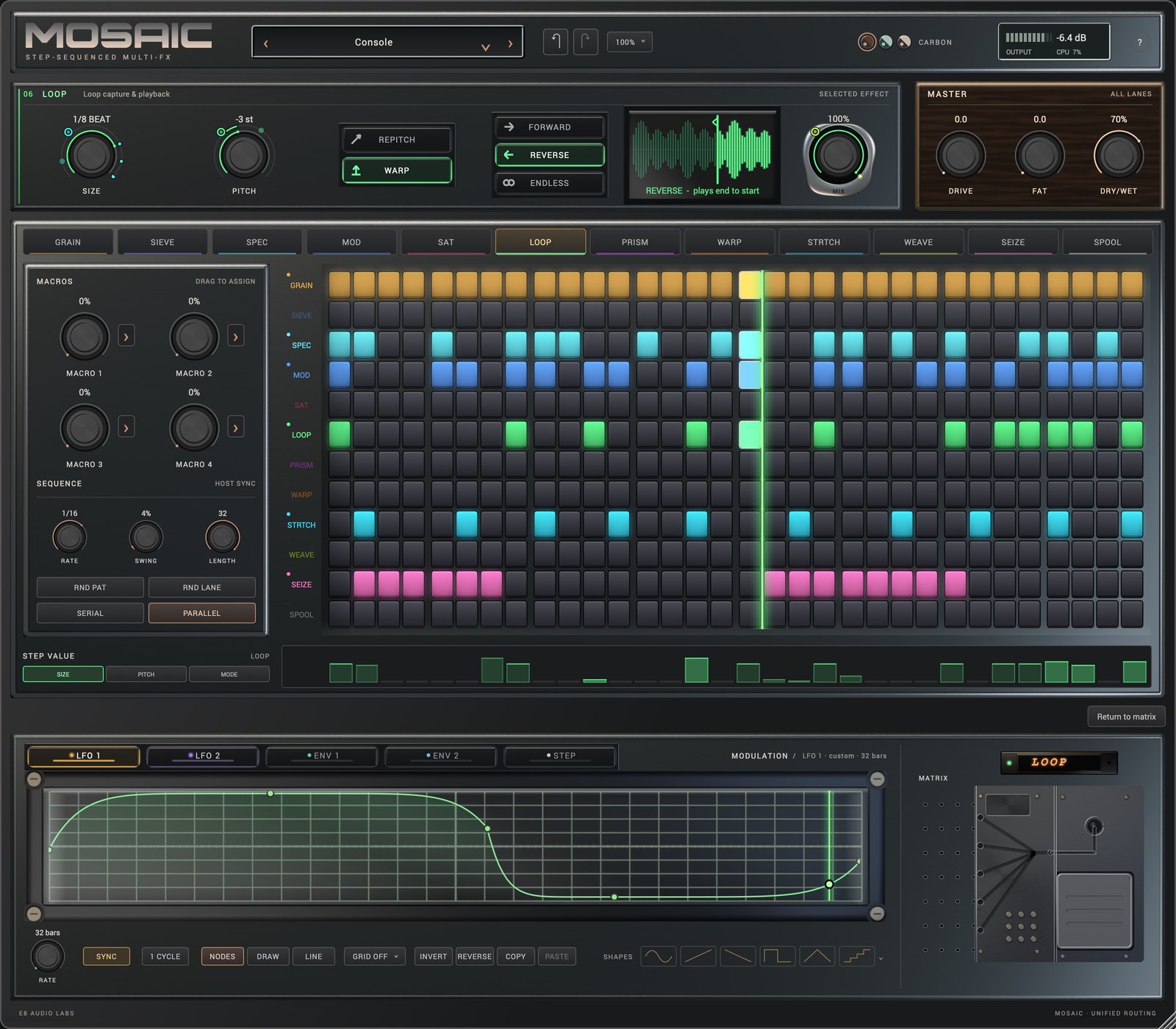
Per-step values, drawable LFO curves, envelopes, and step modulation bring movement to individual parameters. Lane and pattern randomizers generate new combinations you can refine into deliberate variations.
Each lane can follow the global loop length or use an independent length of 2, 4, 8, 16, or 32 steps. Step rates are 1/4, 1/8, 1/16, or 1/32 note.
| Sequencer | 12 effect lanes; up to 32 steps. |
|---|---|
| Modulation | Per lane: 2 LFOs, 2 envelopes and 1 step modulator. 4 global macros. |
| Granular engine | 5–200 ms grains; ±24 semitones. |
| LFO range | 0.05–20 Hz, or tempo sync from 32 bars to 1/64 note. |
| Latency | 1024 samples per SIEVE/SPEC lane (21.3 ms at 48 kHz). Total depends on the active path. |
02 / Collage
Collage: An Introduction
A vector-guided glitch multieffect engine for spectral, granular, saturation, and time-based transformations.
Reshape incoming audio through five reorderable stages: SPECTRAL, GRANULAR, MANGLE, TIME, and PLEAT. Shift and scatter frequency content, rearrange grains, distort and fold waveforms, and manipulate playback rate, position, and pitch.
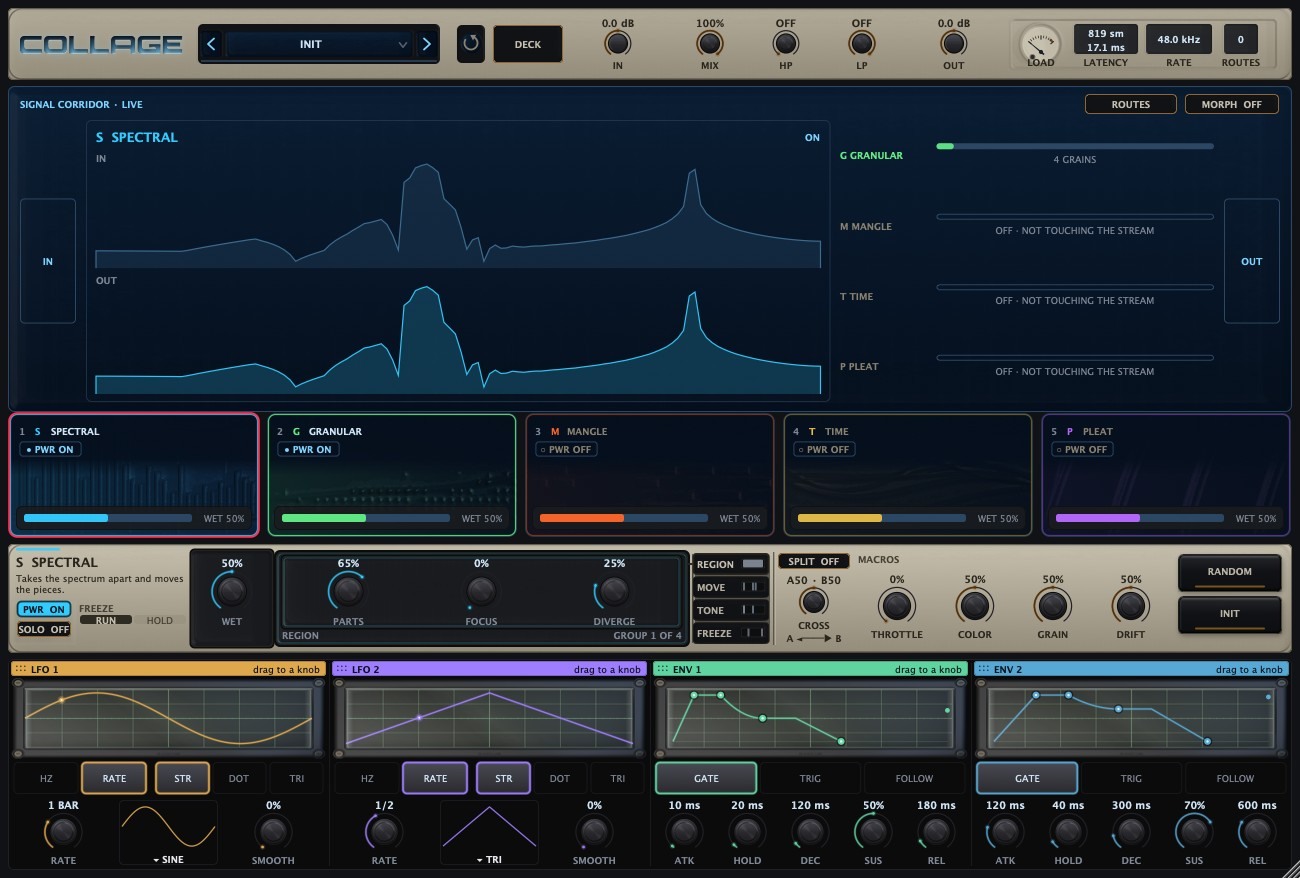
COLLAGE’s vector path, LFOs, envelope followers, and scene morphing drive parameter movement across the rack. Four performance macros and a morph pad connect detailed sound design with live control.
Reorder the stages to explore how each transformation feeds the next, then move between restrained coloration, unstable textures, and complex glitch effects.
| Rack | 5 reorderable stages; serial or 2 parallel lanes. |
|---|---|
| Granular engine | 5–500 ms grains; ±24 semitones. |
| Nonlinear processing | MANGLE and PLEAT: 1–4 shaping stages each. |
| Control and routing | Up to 128 routes; vector paths up to 16 points. |
| Performance controls | 2 LFOs, 2 envelopes, 4 macros and 4 stored scenes. |
| Latency / sample rates | Default FAST tier: 819 samples at 48 kHz (17.1 ms). 44.1–192 kHz supported. |
03 / Temper
Coming Soon: Temper
TEMPER creates sound through interacting physical models: vibrating strings, resonant surfaces, and a shared body that continues responding across notes. Designed for organic plucks, tuned percussion, bowed textures, and experimental hybrids, it lets you shape an instrument’s sound and the mechanics behind it.
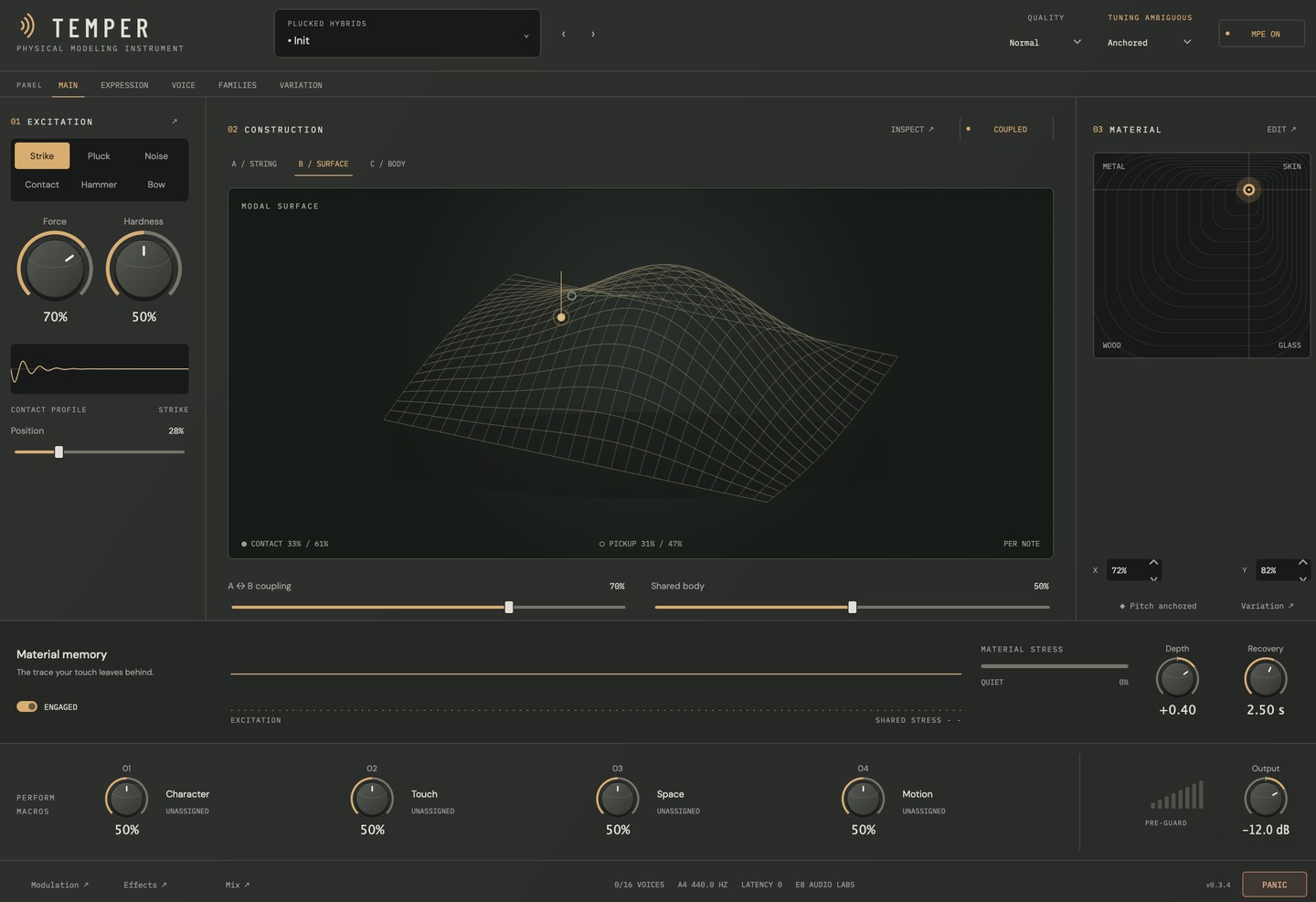
Coupled resonators
Each voice couples a string to a surface through a bridge. The string’s stiffness shapes the spacing of its overtones. Surface configurations include string, bar, plate, membrane, and custom resonances. Stiffness, damping, excitation position, and coupling determine how energy moves through the construction. A persistent shared body connects the voices.
Excitation models
Strike, Pluck, Noise, Contact, Hammer, and Bow introduce energy in different ways. The hammer responds like felt, and the bow like rosin on a string. Force, hardness, and contact position influence attack, harmonic balance, and sustained behavior.
Material Memory
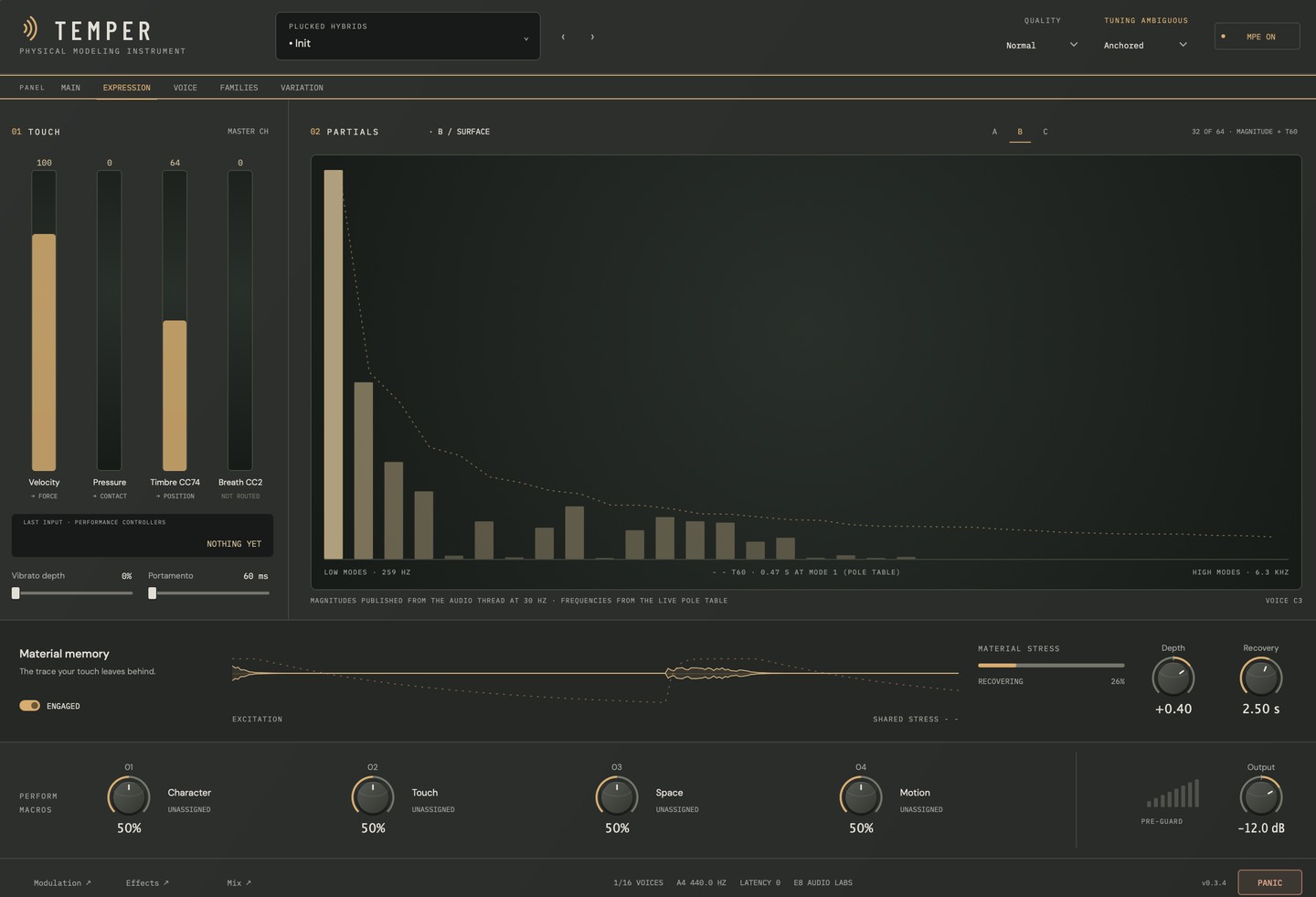
Performance energy and pressure build local and shared stress, which can alter stiffness, damping, and contact softness. Adjustable depth and recovery let those changes accumulate and gradually settle. The construction responds to its playing history.
Material scenes and tuning
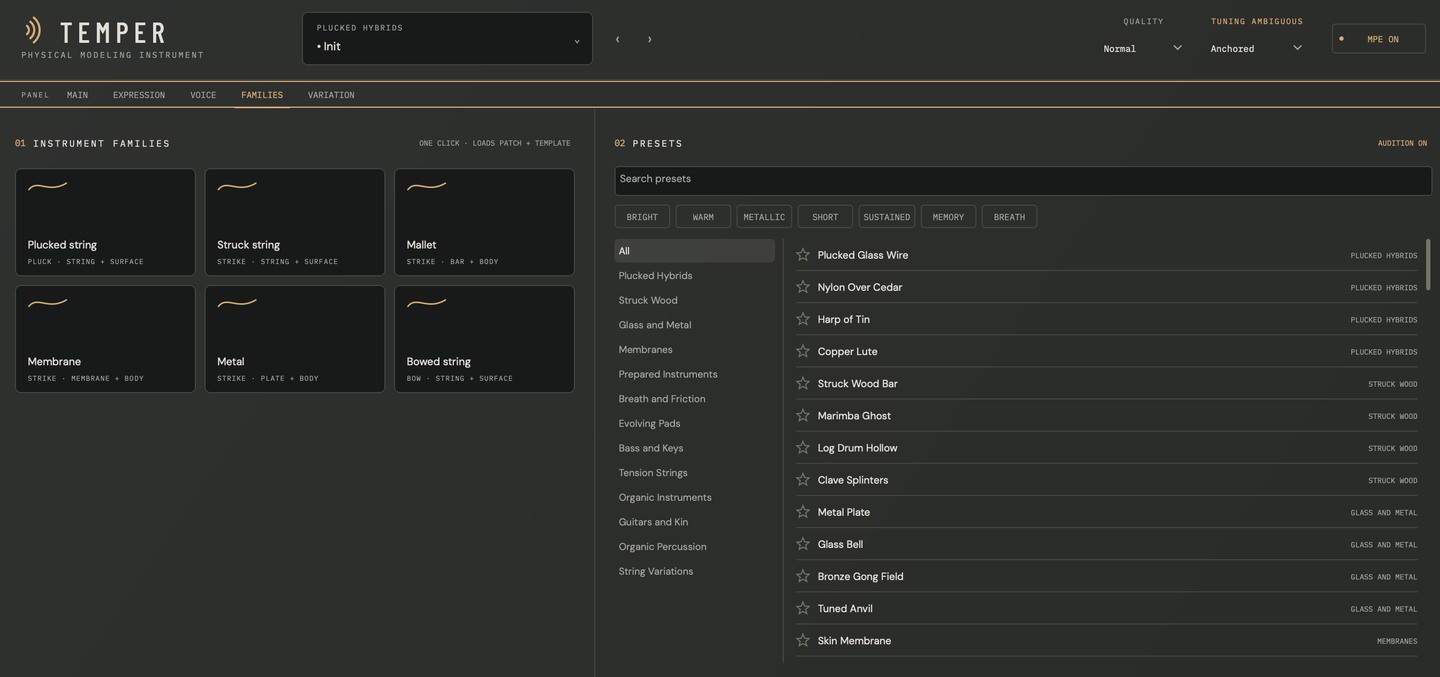
Blend four material scenes through an XY control. Seeded variation produces repeatable alternatives while letting you lock selected characteristics. Anchored tuning calibrates the coupled model toward the intended pitch; Free tuning allows its physical interactions to influence pitch more directly.
Modulation and expression
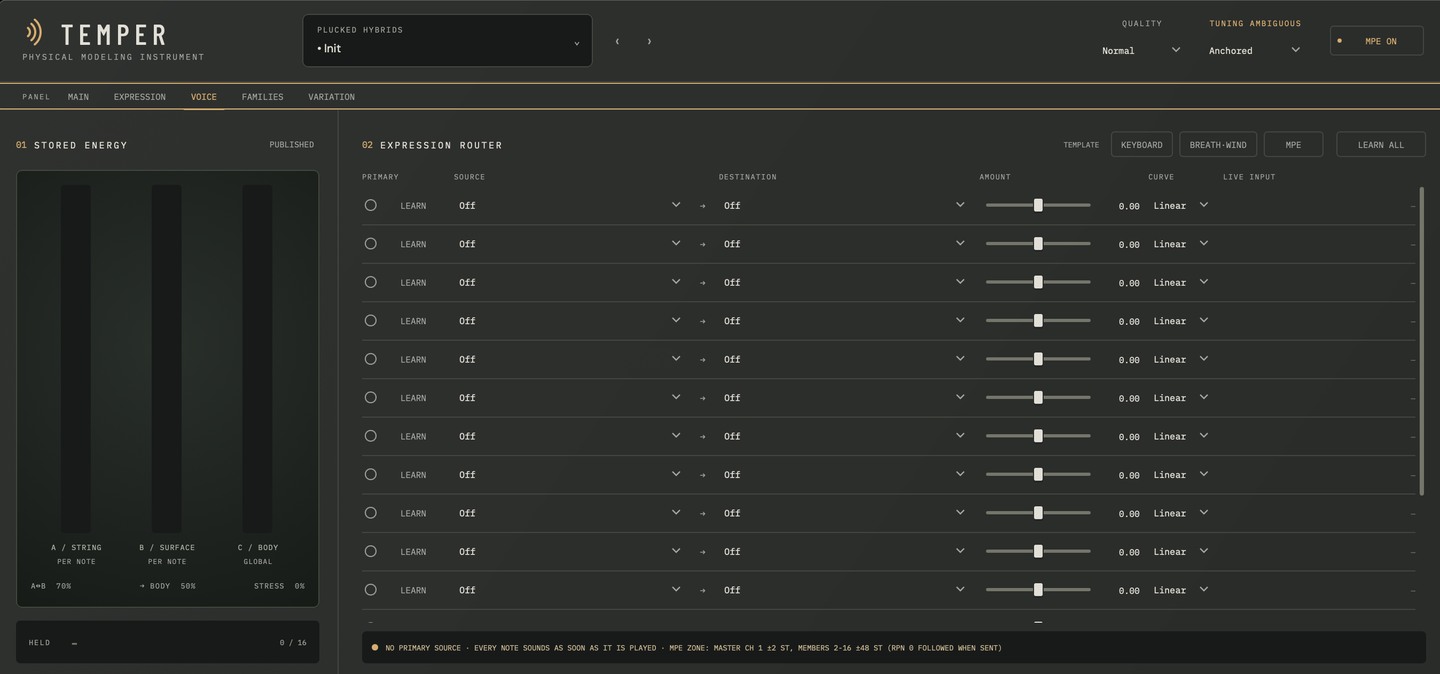
A 16-route modulation system combines tempo-synced LFOs, envelopes, per-note randomization, material stress, and performance controllers. Four assignable macros provide broader control. MPE, pressure, timbre, breath, and release velocity support expressive mappings; three-band EQ, drive, ping-pong delay, and reverb finish the output.
| Polyphony | Up to 16 voices; preset and CPU dependent. |
|---|---|
| Modulation | 16 routes; 2 LFOs; 2 envelopes; 4 macros. |
| Materials / excitation | 4 material scenes; 6 excitation modes. |
| Latency | Linear path: 0 samples. Nonlinear contact: 15 samples. |
| Sample rates | 44.1–192 kHz. |
Nonlinear string presets may use lower voice limits. Specifications describe the current development engine.